
Definition
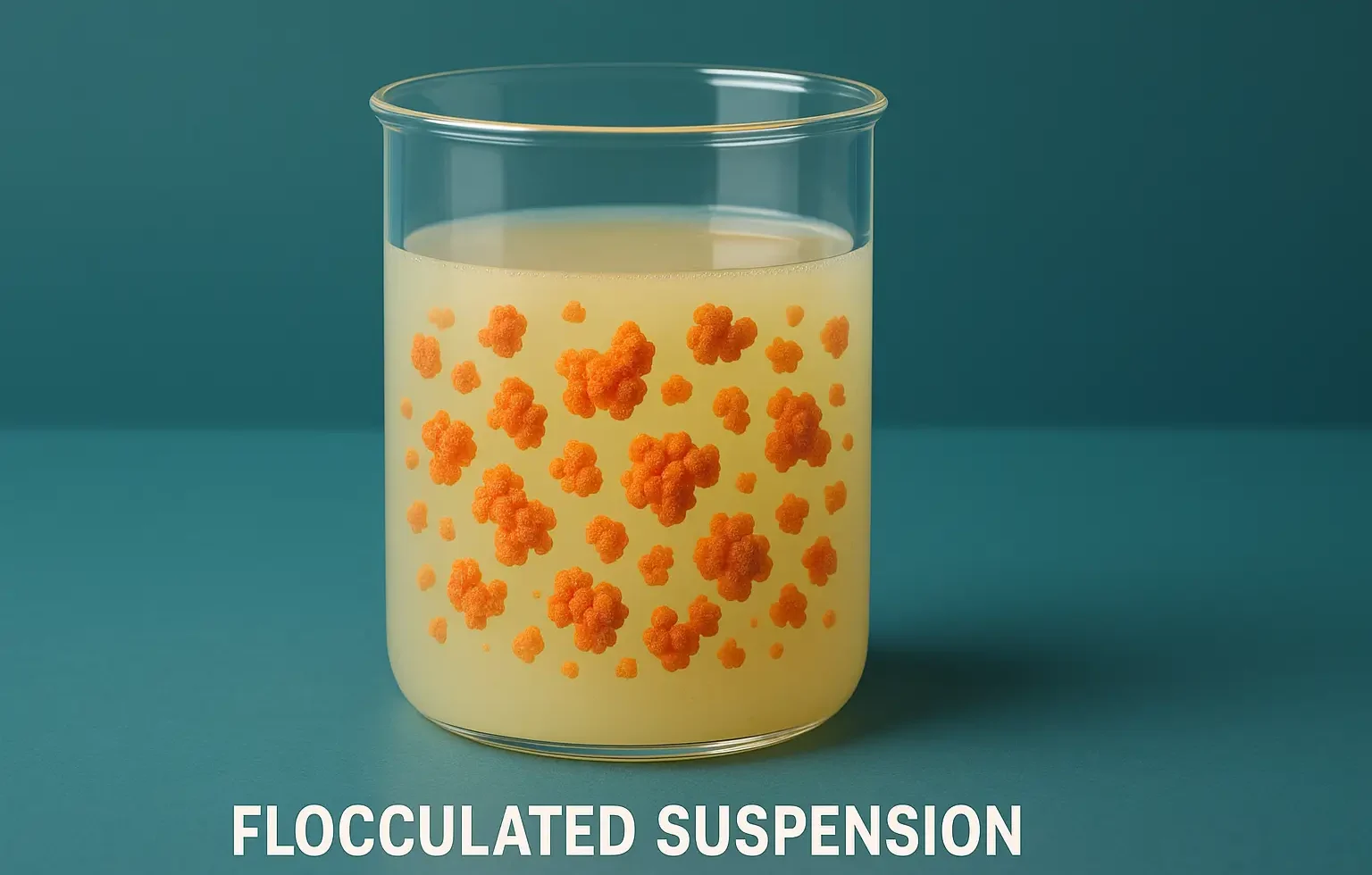
- A flocculated suspension is one in which solid particles form loose, fluffy aggregates called flocs.
- These flocs settle quickly but can be easily redispersed upon shaking.
- Flocculated suspensions are preferred in pharmaceuticals due to their better stability and ease of redispersion.
Preparation of Flocculated Suspensions
Advertisements
-
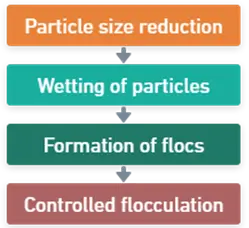
Particle size reduction:
- The solid drug is milled or micronized to achieve a suitable particle size for proper dispersion.
-
Wetting of particles:
- A wetting agent is used to reduce interfacial tension between solid particles and the liquid medium.
-
Formation of flocs:
- A flocculating agent (e.g., electrolytes or polymers) is added to promote the formation of loose, easily dispersible flocs.
-
Controlled flocculation:
- The concentration of the flocculating agent is adjusted to achieve the desired degree of flocculation without excessive settling or caking.
Stability Problems & Solutions
-
Sedimentation:
- Problem: Rapid settling can lead to uneven dosing and difficulty in redispersion.
- Solution: Adjust flocculating agent concentration and increase the viscosity of the medium with thickening agents like hydroxyethyl cellulose or xanthan gum to slow sedimentation.
-
Caking:
- Problem: If flocs settle too tightly, they may form a hard cake that is difficult to redisperse.
- Solution: Optimize flocculation by adjusting flocculating agents and increasing viscosity with suitable thickeners. Shake the suspension gently before use.
Advertisements