
- The HMP shunt (Hexose Monophosphate), also known as the Pentose Phosphate Pathway (PPP), is a crucial cytoplasmic pathway that supports cellular functions such as NADPH production and ribose-5-phosphate synthesis.
- It is essential for biosynthetic processes and protection against oxidative stress.
HMP Shunt Pathway / Phases of the HMP Shunt
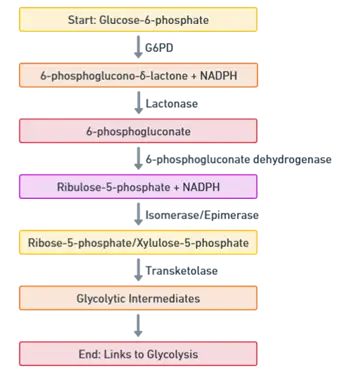
- The pathway is bifurcated into two main phases: the oxidative phase, which generates NADPH, and the non-oxidative phase, which produces ribose-5-phosphate and allows for the interconversion of sugar phosphates.
-
Oxidative Phase:
- Glucose-6-phosphate Dehydrogenation: Converts glucose-6-phosphate to 6-phosphoglucono-δ-lactone, producing NADPH.
- Lactonase Action: Converts 6-phosphoglucono-δ-lactone to 6-phosphogluconate.
- Decarboxylation: 6-phosphogluconate is decarboxylated to ribulose-5-phosphate, generating more NADPH.
-
Non-Oxidative Phase:
- Interconversions: Converts ribose-5-phosphate, ribulose-5-phosphate, and xylulose-5-phosphate.
- Formation of Glycolytic Intermediates: Transketolase and other enzymes convert sugar phosphates into glycolytic intermediates like fructose-6-phosphate and glyceraldehyde-3-phosphate.
Advertisements
Significance of the HMP Shunt
-
NADPH Production:
- Supports anabolic processes like fatty acid and cholesterol synthesis.
- Maintains reduced glutathione, protecting cells from oxidative stress.
-
Ribose-5-phosphate Production:
- Essential for nucleotide and nucleic acid synthesis, critical for rapidly dividing cells (e.g., immune and bone marrow cells).
-
Metabolic Flexibility:
- Allows cells to balance between energy production (via glycolysis) and the need for biosynthetic precursors, providing adaptability in response to metabolic demands.
- This streamlined overview highlights the importance of the HMP shunt in cellular metabolism and defense against oxidative damage.