
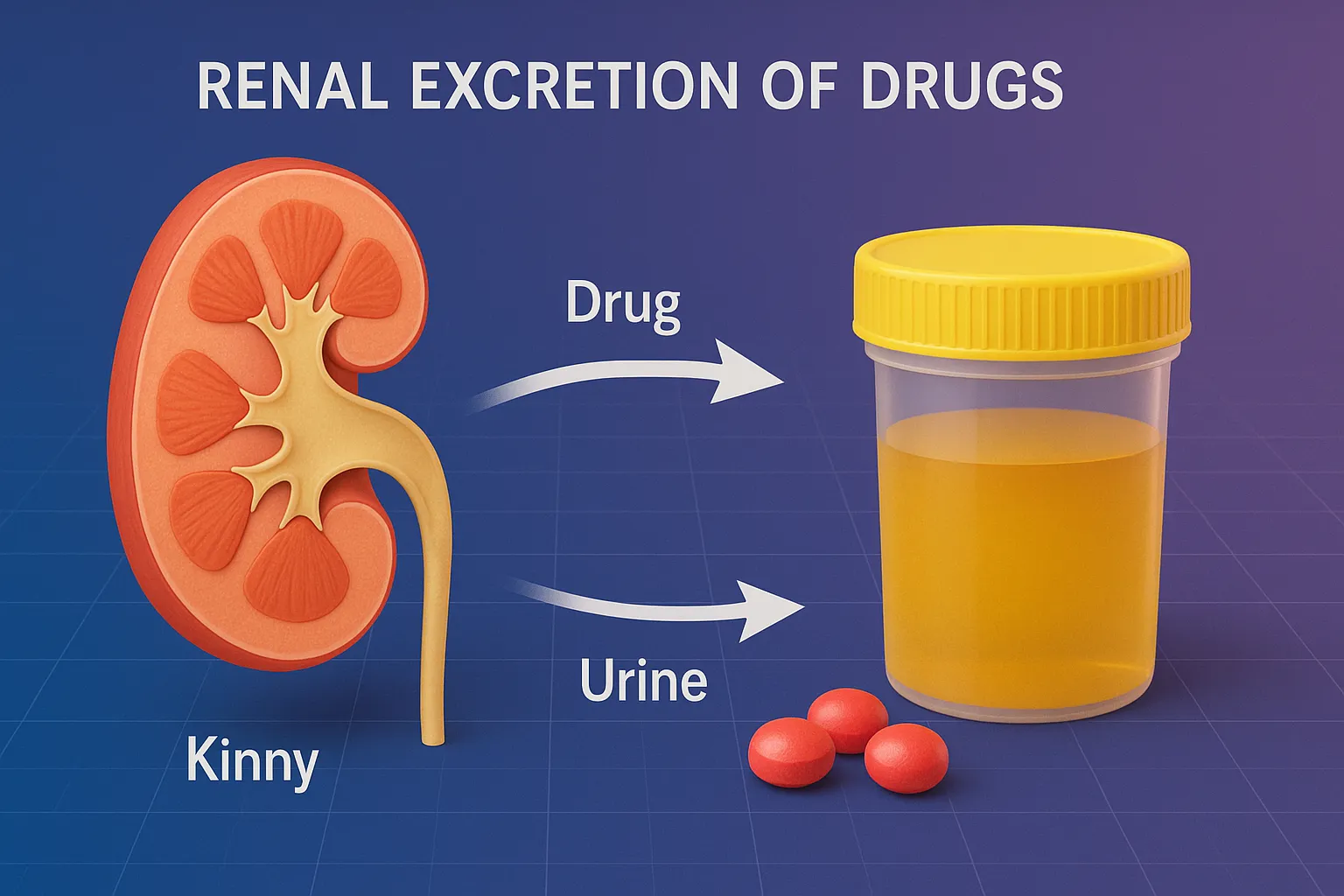
- Renal Excretion of Drugs involves filtration, secretion, and reabsorption processes that remove drugs through the kidneys.
Renal Excretion of Drugs
- After metabolism (or sometimes directly if they are already sufficiently water-soluble), drugs and their metabolites are excreted from the body.
- The kidneys are the primary route for most water-soluble agents.
Basic Renal Anatomy & Physiology
- Each kidney consists of about a million nephrons, which are the functional units. A nephron includes:
- Glomerulus: Site of filtration of plasma.
- Proximal tubule: Important for active secretion and some reabsorption.
- Loop of Henle
- Distal tubule
- Collecting duct
Processes Involved in Renal Excretion
- The kidneys are the major route for drug excretion, especially for water-soluble drugs and metabolites. Renal excretion involves three main processes:
Advertisements
-
Glomerular Filtration
- Occurs in the glomerulus where drugs with low molecular weight (<500 Da) and unbound (free) drug molecules are filtered into the renal tubule.
- Factors affecting glomerular filtration:
- Molecular size – Small molecules are filtered easily.
- Plasma protein binding – Only unbound drugs are filtered.
- Renal blood flow – Increased renal perfusion enhances filtration.
-
Tubular Reabsorption
- In the proximal and distal tubules, drugs can be reabsorbed back into the bloodstream, reducing elimination.
- Lipid-soluble, non-ionized drugs are easily reabsorbed, while polar, ionized drugs remain in urine and are excreted.
- Urinary pH affects reabsorption:
- Acidic urine favors excretion of basic drugs (e.g., amphetamines).
- Alkaline urine favors excretion of acidic drugs (e.g., aspirin).
-
Tubular Secretion
- Active transport in the proximal tubule secretes drugs into urine.
- Two carrier-mediated transport systems exist:
- Organic anion transporters (OATs) – Secrete acidic drugs (e.g., penicillin, furosemide).
- Organic cation transporters (OCTs) – Secrete basic drugs (e.g., morphine, amiloride).