

Source and Occurrence of Caffeine

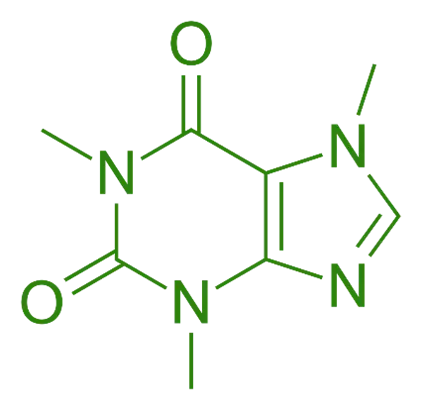
- Caffeine is a purine alkaloid found in Coffee beans (Coffea spp.), Tea leaves (Camellia sinensis), Cacao beans (Theobroma cacao), and Kola nuts (Cola spp.).
- It is a central nervous system stimulant.
Advertisements
Isolation
-
Extraction:
- Solvent Extraction: Ground coffee beans or tea leaves are extracted with water or organic solvents like dichloromethane or ethyl acetate.
-
Purification:
- Liquid-Liquid Extraction: Using solvents of different polarities to separate caffeine from other components.
- Crystallization: Caffeines can be crystallized from hot water as it is highly soluble when heated.
-
Chromatography:
- Column Chromatography: Using silica gel with appropriate eluent systems (e.g., chloroform-methanol).
- HPLC: For higher purity requirements.
Advertisements
Identification
-
Physical Properties:
- Appearance: White crystalline powder.
- Melting Point: Approximately 238°C.
- Solubility: Highly soluble in water, methanol, and chloroform.
-
Spectroscopic Techniques:
- IR Spectroscopy: Identifies functional groups like carbonyl and amine groups.
- NMR Spectroscopy:
- ¹H NMR: Provides information on methyl groups and other proton environments.
- ¹³C NMR: Confirms the carbon skeleton of caffeine.
- Mass Spectrometry: Molecular ion peak at m/z 194 (free base).
-
Chromatographic Techniques:
- HPLC: Essential for purity assessment and quantification.
- GC-MS: Possible but may require derivatization due to caffeine’s thermal stability.
Analysis
-
Quantitative Analysis:
- HPLC with UV Detection: Standard method for caffeine determination in beverages and pharmaceuticals.
- Spectrophotometric Methods: Using specific absorbance peaks for caffeine.
-
Quality Control:
- Ensuring high purity for pharmaceutical applications.
- Verifying absence of related xanthine alkaloids like theobromine and theophylline.
Advertisements
Applications and Significance of Caffeine
- Caffeines are widely consumed for its stimulant effects, enhancing alertness and reducing fatigue.
- It is also used in headache remedies, weight loss supplements, and as an additive in various food and beverage products.